

Understanding Digital Marketing Funnels and How They Work
In digital marketing, gaining visibility is only the beginning of the journey. Many businesses invest time and money into driving traffic through advertisements, social media platforms, and search engines, yet still find it difficult to turn visitors into paying customers. The missing link is often a clear process that guides people from initial interest to meaningful action. This is where Digital Marketing Funnels play a crucial role. Digital Marketing Funnel help businesses understand how users interact with a brand over time and how decisions are made at each stage of the journey.
A digital marketing funnel is not a complicated system, but it is frequently misunderstood or overlooked. At its core, it represents the path a potential customer follows—from first discovering a business, to learning more about its offerings, to eventually trusting the brand enough to take action. Rather than treating every visitor the same, funnels allow businesses to deliver the right message at the right moment, making marketing efforts more relevant and effective.
When used thoughtfully, digital marketing funnels help reduce unnecessary spending, improve communication, and increase conversion rates without constantly increasing budgets. They bring structure to marketing strategies and clarity to customer behavior. This guide explores digital marketing funnels in a simple, practical, and human-centered way, explaining what they are, how they function, why they are important, and how businesses can use them to build sustainable growth.
What Is a Digital Marketing Funnel?

A digital marketing funnels is a structured way to understand how people engage with a business throughout their decision-making process. It illustrates the different stages a potential customer passes through, from the first moment they become aware of a brand to the point where they finally take action. The term “funnel” is used because, while many people may show initial interest, only a smaller group continues forward and completes the desired action.
Every individual who comes across a business online is at a different stage of readiness. Some may simply notice a brand for the first time through an advertisement or a social media post. Others might already be researching solutions, comparing options, or evaluating whether the business can meet their needs. Very few are ready to make an immediate decision. A digital marketing funnel helps businesses recognize these differences and respond appropriately instead of treating all users the same.
By using a funnel-based approach, businesses can share relevant information at each stage rather than pushing sales messages too early. This makes communication feel more natural and helpful to the audience. In practical terms, a digital marketing funnel helps answer three essential questions: where the customer currently stands in their journey, what type of information or reassurance they need next, and how the business can guide them smoothly toward the next step. When applied correctly, funnels create clarity, improve engagement, and support better long-term conversions.
Why Digital Marketing Funnels Are Important

Without a funnel, marketing efforts often feel scattered. Businesses may run ads, post on social media, or write blogs, but without a clear direction. Funnels bring structure and purpose to digital marketing.
One of the biggest advantages of using funnels is clarity. Businesses stop treating all users the same and start understanding intent. Someone visiting a website for the first time should not be treated the same as someone who is ready to buy.
Funnels also help improve conversion rates. Instead of trying to sell immediately, businesses focus on building awareness, trust, and confidence step by step. This approach feels more natural to customers and leads to better long-term results.
Additionally, funnels help save time and money. When businesses know which stage needs improvement, they can optimize specific parts instead of changing everything at once.
The Core Stages of a Digital Marketing Funnel
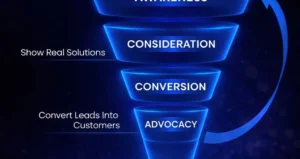
While funnels can vary depending on the business, most digital marketing funnels follow a similar structure. The most common model includes awareness, consideration, conversion, retention, and advocacy.
Awareness Stage

The awareness stage is where the journey begins. At this stage, people are not actively looking to buy. They are simply discovering a brand, product, or solution for the first time.
This can happen through search engines, social media posts, ads, videos, referrals, or blog content. The goal here is not to sell, but to make people aware that a solution exists.
Content at the awareness stage should be informative and helpful. Blogs, educational videos, social media content, and introductory ads work well here. The focus should be on addressing problems, answering basic questions, and creating curiosity.
A common mistake businesses make is pushing sales too early at this stage. Instead, the priority should be visibility and trust.
Consideration Stage

Once people are aware of a brand, they move into the consideration stage. Here, users are interested and actively learning more. They may compare options, read reviews, subscribe to emails, or explore a website in detail.
At this stage, trust becomes critical. People want to know whether a business understands their problem and whether its solution is reliable. Content should be more detailed and value-driven.
Examples of consideration-stage content include in-depth blogs, comparison guides, case studies, webinars, email sequences, and testimonials. The goal is to educate, not pressure.
Businesses that succeed at this stage focus on clarity and credibility rather than aggressive selling.
Conversion Stage

The conversion stage is where users take action. This could mean making a purchase, filling out a contact form, booking a call, or signing up for a service.
At this point, users are already interested. What they need is reassurance and simplicity. Complicated processes, unclear pricing, or lack of trust signals can cause drop-offs.
Effective conversion-stage elements include clear calls to action, simple landing pages, transparent pricing, social proof, and easy checkout or contact options.
Conversion does not always mean a sale. It means the desired action defined by the business.
Retention Stage
Many businesses stop marketing after conversion, which is a missed opportunity. The retention stage focuses on keeping customers engaged after they take action.
Retained customers are more likely to buy again, trust the brand, and recommend it to others. Retention is often more cost-effective than acquiring new customers.
Retention strategies include follow-up emails, onboarding content, customer support, loyalty offers, updates, and helpful resources. The goal is to build a long-term relationship, not just a one-time transaction.
Advocacy Stage

The advocacy stage is where satisfied customers become promoters of the brand. They leave reviews, share experiences, and recommend the business to others.
This stage is powerful because people trust other people more than ads. Word-of-mouth, testimonials, and referrals significantly influence buying decisions.
Businesses can encourage advocacy by providing excellent service, requesting reviews, offering referral programs, and maintaining strong customer relationships.
Types of Digital Marketing Funnels
Not all funnels are the same. Different businesses use different funnel types depending on their goals.
A lead generation funnel focuses on collecting contact information through forms, free resources, or subscriptions. An e-commerce funnel is designed to guide users toward product purchases. A content funnel focuses on educating users over time through blogs, emails, and videos. A sales funnel is often used for services and high-ticket offers where trust-building is essential.
Understanding the right funnel type helps businesses design better strategies.
Digital Marketing Funnels for Small Businesses

Digital marketing funnels are especially helpful for small businesses because they bring structure and direction to marketing efforts. Instead of trying every platform or strategy at the same time, funnels help businesses focus on guiding customers step by step. SEO and content marketing are useful for creating awareness and attracting the right audience. During the consideration stage, reviews, testimonials, and email communication help build trust and keep the business in mind. For conversions, simple landing pages, clear offers, and easy calls to action make it easier for customers to take the next step. After conversion, follow-ups and customer support strengthen relationships and encourage repeat business. With a well-planned funnel, small businesses can grow steadily using smart strategy rather than large budgets.
Digital Marketing Funnels for Large and Global Businesses

Larger businesses often use more complex funnels with automation, segmentation, and multiple touchpoints. They focus heavily on data, personalization, and long-term engagement.
For these businesses, funnels help manage scale. Different audiences may be at different stages, and funnels help deliver relevant messaging to each group.
Common Mistakes in Digital Marketing Funnels

One common mistake is treating all users the same. Another is focusing too much on conversion while ignoring awareness or retention. Some businesses also overcomplicate funnels, making them confusing instead of helpful.
Ignoring data is another issue. Funnels should be analyzed regularly to identify drop-off points and opportunities for improvement.
How SEO and AEO Fit Into Funnels
Search Engine Optimization (SEO) and Answer Engine Optimization (AEO) play a critical role in strengthening digital marketing funnels by ensuring that the right audience discovers and engages with a business at the right stage of their journey. SEO primarily supports the awareness and consideration stages by helping websites rank for relevant search queries, attracting users who are actively looking for information, solutions, or comparisons. Through well-structured content, strategic keyword usage, optimized technical performance, and clear intent alignment, SEO brings consistent organic traffic into the top of the funnel. AEO builds on this foundation by optimizing content to appear as direct answers in voice searches, featured snippets, and AI-generated responses, increasing visibility in environments where users expect immediate and precise information. While SEO focuses on ranking across search results pages, AEO focuses on positioning content as the most accurate and helpful response to specific questions. Together, they improve discoverability, enhance credibility, and guide users smoothly from initial awareness to deeper consideration, ensuring that funnels attract qualified visitors who are genuinely interested rather than random traffic that fails to convert.
Measuring Funnel Performance
Funnels should not be guessed; they should be measured. Metrics such as traffic, engagement, conversion rates, bounce rates, and retention rates help evaluate performance.
By understanding where users drop off, businesses can improve specific stages instead of changing everything blindly.
Final Thoughts

Digital marketing funnels are not about manipulation. They are about understanding human behavior and guiding people naturally through their decision-making process. When businesses respect the customer journey, marketing becomes more effective and more meaningful.
A well-built funnel brings clarity, improves conversions, and supports sustainable growth. Whether a business is small or large, local or global, digital marketing funnels provide a structured way to turn attention into trust and trust into action.
In an increasingly competitive digital space, businesses that understand and apply funnel thinking are far better equipped to grow consistently and confidently.
Author : Suhana